


In the kitchen
Palaeolithic humans have obtained their food by hunting and gathering. This way of subsistence, however, was able to feed only a small population. The transition to agriculture enables the society to produce a surplus and the number of inhabitants of the planet Earth grows constantly up. People at the same time remain dependent on harvest and each deficiency may be fatal. In prehistoric cultures as well as medieval communities, the preparation of meals and dining thus must have had a fundamental or even sacred meaning.
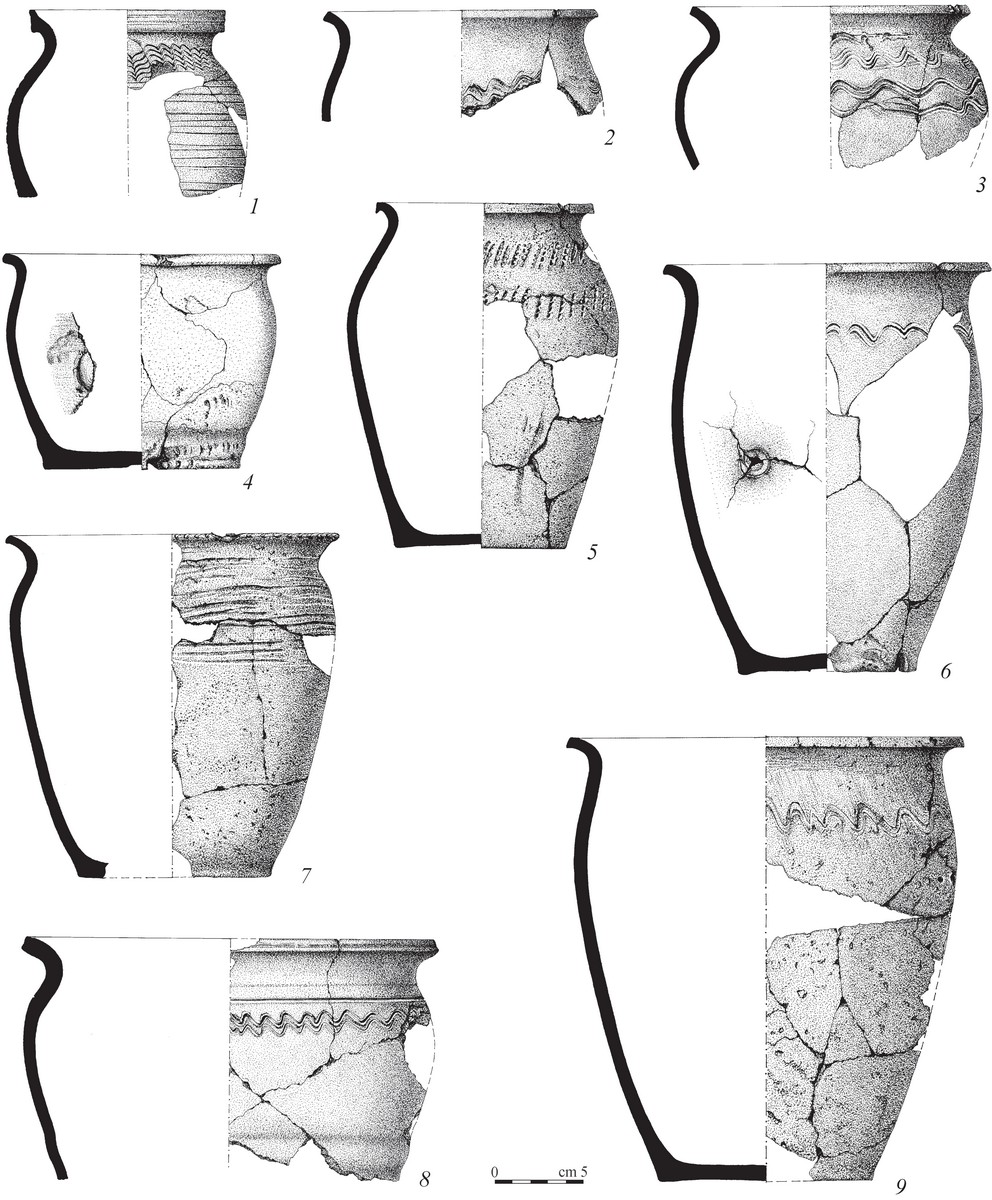
Examples of Slavic ceramics
The Lusatian culture, whose people have built the first hillfort at Chotěbuz, existed earlier than any written sources concerning our territory. The importance of dining was a matter of course in this period as well. The elite warrior classes demonstrated and strengthened their exclusivity through the medium of collective dining. Tangible evidence is provided by grave finds: the dead were laid into graves equipped with high-quality, richly decorated ceramic vessels – bowls, jars, beakers. As if a sort of last feast would await them in the afterworld.
In the Slavs – the second inhabitants of Chotěbuz, the ceremonial preparation of some meals and collective feasting are evident. Moreover, they are also known from ethnographic analogies. The old custom of greeting the guests with bread and salt, which in some regions survived until today, is rooted in the Early Middle Ages.
Unlike pottery, which after millennia in the ground can seem as if it were thrown away yesterday, foodstuffs spoil quickly. We can suppose that everyday food was based on cereals, but according to the amount of bones found, meat was not entirely rare, either.

The rotary hand quern
Bread has already been baked in the New Stone Age. Its oldest form probably represented unfermented flatbread, later the yeast bread also appeared. In Central Europe still at the beginning of the Iron Age, grain has been crushed with the help of a saddle quern with a handstone (also called rubber) moved back and forth. Obtaining meal in this way is wearing and lasts very long – to enhance the quality it must be sieved and crushed again. This process did not change until the La Tène Culture when the use of small rotary hand querns has been implemented on the Celtic territory. Grain was poured through a central hole (eye) into the space between the bottom stone (quern) and the upper rotating stone (handstone) and the ground flour fell out at the edges. Such a hand quern is much more effective and faster. This device then survived in various modifications until the Middle Ages when large mills became widespread. But as a stopgap measure, small hand querns could still be found in cottages at the beginning of the 20th century. In the Chotěbuz-Podobora hillfort also occurred such querns dating from the 9th century.
For the Slavs living at Chotěbuz, bread was the most common food which has been consumed by all social classes. To us it would probably seem as the present-day wholemeal bread, the intensity of its dark colouring depended on the baking method used. The bread samples preserved also show that the dough has commonly been salted or enriched with various additives such as herbs and spices.
Did you know that:
The 12th century historian Saxo Grammaticus described pagan rituals which have been observed by the Slavs on the Rügen Island. He reported to have seen a ceremony, in which a priest of Svantovit deity first examined whether this god has accepted the wine offering. Subsequently a large honey cake was brought, whose dimensions are said to have been so immense that a man could hide behind it. The priest asked the assembled people whether they saw him and they answered him ritually they did. He then responded that he wished they would not see him the next year – that is may there be abundant prosperity and may the cake be larger.
We must not forget festive pastry, either. In prehistory we would only be in the realm of speculations, but in the Early Middle Ages we suppose the existence of sweet pastry, above all cakes.
Another category of everyday food is represented by cereal porridges. The examples found throughout Europe show that prehistoric porridges were usually salted or abundantly greased. We also have evidence of baked porridges, whereas sweet porridges were less frequent. The main prehistoric sweetener was honey, but we can also suppose the use of dried fruit. We should not forget other cereal meals, either. Particularly popular with the Slavs were cooked millet grains. One part of grain was harvested before ripeness, at the time of the so-called milk ripeness when it can without any problems be directly consumed. Unripe grain was roasted as well, which produces a naturally sweetish taste.
Evidence of meat preparation in the kitchen is very abundant. We often find chopped or crushed bones or bones bearing distinct traces of heat treatment. From several animals such as, for example, pigs, we often find only teeth and skull fragments. The animal was almost completely processed, from the skin over the meat and fat through to bones as an important material. Meat has been backed, boiled as well as stewed, frying was probably more difficult.
In the kitchen have also been used various seasonings. We have already mentioned that the main sweetener was honey, or fruit respectively. Maple or birch syrups also may have been used. Spices were mainly represented by domestic plants such as caraway, sorrel, cress, marjoram, mint, parsley, mallow and others. Medieval elite classes may have also afforded products of long-distance trade – cinnamon, cloves, pepper, etc. An imported commodity was salt, which was probably also used in poorer households, even though it was still relatively expensive. We also know finds of objects which have probably served as salt cellars. Vinegar has been made from fruit at the end of prehistory already.
Another important food were legumes, above all pea and lentil. Pea was widespread, from later times we know many sweet as well as salty variants of its preparation.
Did you know that:
The Early Iron Age site of Hallstatt in Austria, for example, yielded abundant evidence of carrot growing. The then carrot, however, was quite seedy, not very sweet and rather “rooty”. Therefore it has not been grown as a vegetable but because of the seeds which were used as spices.
Vegetables and fruit should not be forgotten, either. However, we must take into account that the present-day crops are a result of centuries-long genetic modifications, that is breeding – the prehistoric and early medieval vegetables would not be really attractive to us today. From the prehistory as well as from the Early Middle Ages we know evidence of apples, pears, cherries, sloes and plums. Apricot was not widespread here, but peaches, which were not known to prehistoric humans, were very popular with the Slavs. Walnut was not proved until the 9th century, however, we do not know how it was distributed. As far as “exotic” fruit is concerned, figs, almonds and raisins were already imported in the Early Middle Ages.
Did you know that:
Brewing of beer is a prehistoric invention probably from the time around the year 3,000 BC. Beer initially did not contain hop and it was often seasoned with various aromatic herbs. In the 10th century, however, hop is already evidenced. Various variants of beer were known; prehistoric and early medieval beers were probably relatively weak but very nutritious. The significance of beer consists in the fact that the possibility of occurrence of germs is lower with beer than with water, and beer at the same time provides human body with important nutrients and energy.
The fundamental and inevitable drink was water. Wells have been dug, but people preferred natural running water. In prehistory already we can suppose drinking of herbal decoctions and seasoning of water with sweet tree sap. A particularly important beverage was beer. Also important to the Slavs was mead. During the Hallstatt Period, wine was not yet cultivated on our territory but it was very important in the Mediterranean region. The Greeks and the Romans have promoted it to an alcoholic beverage of particular cultural significance, which was still accentuated by the spread of Christianity, in which wine plays a symbolical role. The Slavs have already known and cultivated wine.