


Plant growing
The humans switched to agriculture as the main source of food within the so-called Neolithisation process at the beginning of the New Stone Age (Neolithic). The Neolithic in the Near East began approximately in the 10th – 9th millennia BC, on our territory the earliest farmers (Linear Pottery Culture) appeared in the 6th millennium BC. This was the most fundamental change which the humans have experienced in the course of their long evolution. The sedentary way of life and production of a surplus is associated with the need of a more complicated organisation of society and it represents the beginning on the way to the first states.
Archaeological excavations at the site of Chotěbuz-Podobora also prove the importance of agriculture. The fields themselves are hard to identify, but we find remnants of tools and equipment as well as of the plants cultivated. From Chotěbuz-Podobora we also know such finds of stored supplies.
At the time of prehistoric occupation in the hillfort at the turn between the Bronze Age and the beginning of the Iron Age, agriculture was not really different from previous periods. The fields have been cultivated with the help of wooden ards; Bronze Age ploughshares are not preserved, iron ploughshares have penetrated from the Near East to Europe during the Early Iron Age. The tillage was supplemented with wooden hoes, shovels, various spikes etc. In these tools as well the use of iron has gradually increased. Harvest has been done with the help of bronze sickles, which were still used for a relatively long time during the Iron Age. Iron sickles appeared parallel to them later.
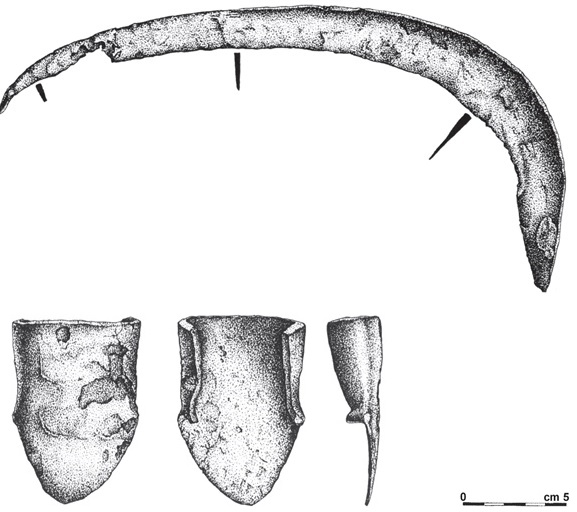
The sickle and iron ploughshare
Iron tools were more common with the Early Middle Ages. The ards were much more often equipped with an iron blade. The variety of crops in the Slavic Period was a little wider; moreover, a two-field system was widespread where one part of the arable land was left fallow and the other was planted with cereals. This on the one hand considerably increases productivity but, on the other hand, the demand for the extent of fields increases, which in the course of time leads to colonisation of new territories (this development, however, was gradual and long-term and did not culminate until the 13th century).
Did you know that:
Foxtail millet is very rare among the finds from the Czech Republic. It is a cereal crop very similar to broomcorn millet, and its occurrence in Central Europe is interesting from a cultural point of view. It was widespread in the Mediterranean region, and its presence thus indicates contacts to Southern Europe.
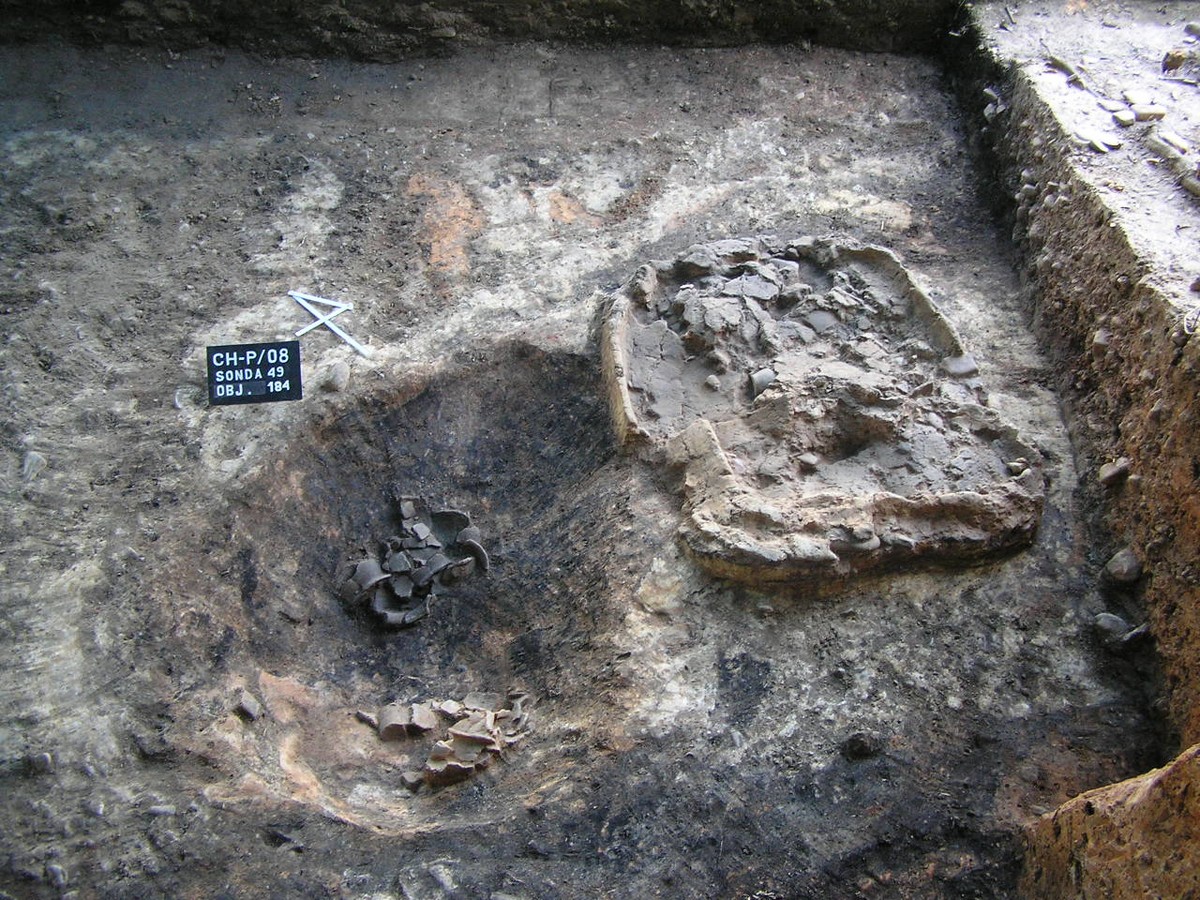
The roasting tray and fragments of vessels
Due to modern methods of archaeobotanical analysis, archaeologists are able to determine with accuracy which crops have been cultivated in the past. We can often find charred grain or seeds of other plants; using the microscopic analyses we can identify the pollen present. Among the most important crops we would find above all wheat and barley. Another significant crop was broomcorn millet, which also was identified in the hillfort. Interesting is the confirmed existence of foxtail millet, whose grains were found clustered in the hillfort. Microscopic pollen analyses proved the presence of buckwheat and rye; also possible is oat. The Slavic diet comprised a relatively high ratio of legumes; from the site under review we know the evidence of pea, and lentil would not be surprising, either. Remnants of flax also were found in the hillfort – it may have been cultivated as a source of both oil and textile fibres.