


Layout Of The Hillfort
A typical hillfort used natural terrain features for its defence, so it is situated either at elevated places or in river floodplains. Chotěbuz-Podobora is an example of the former type: Steep slopes of the local river terrace are ideal for defence, whereas the moderate side offers a comfortable access and at the same time a sufficient space for not only the construction of various types of settlement features but also for the development of defensive elements.
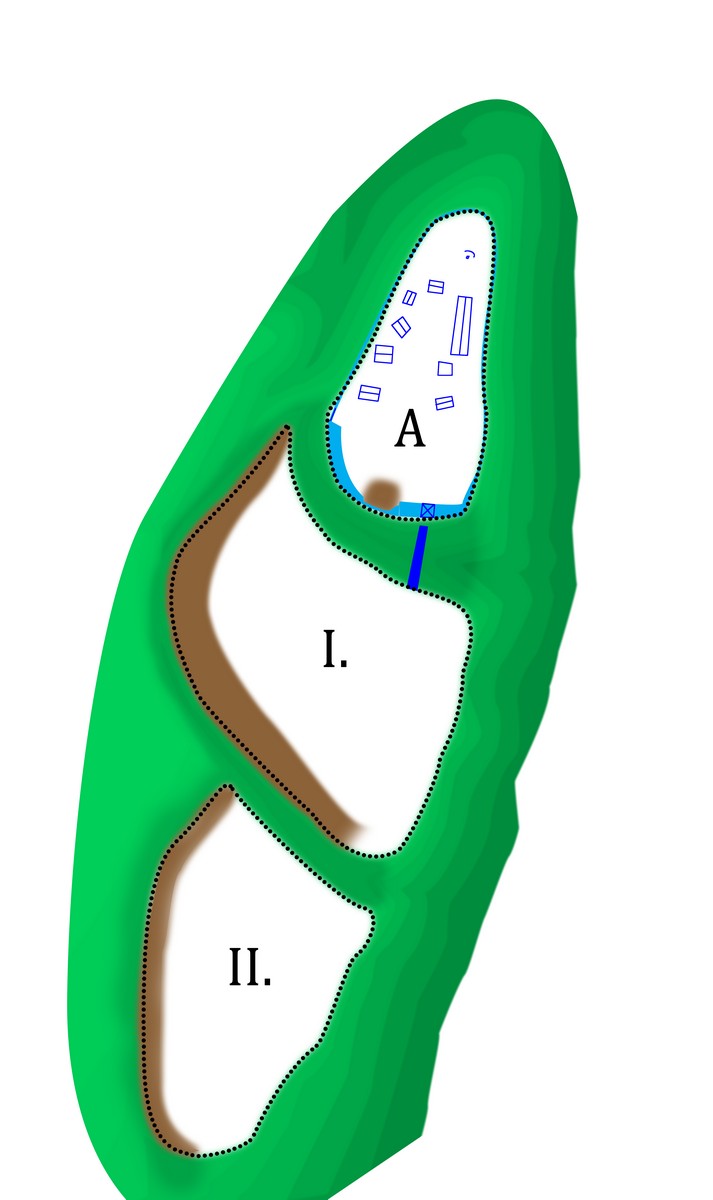
The fortified area covers about 1.7 ha. The whole internal area is divided into three parts, which are separated from each other by ditches and ramparts protecting the hillfort as a whole as well.
On the spur of the hill there is the so-called acropolis – the highest-situated, best defendable place within the whole locality. The main fortification of the acropolis consisted of a mighty rampart on the southwest side, with a wide ditch separating it from the first outer bailey. Its present length is 60 m, the height from the bottom of the ditch reaches as much as 8 m. The original rampart of smaller dimensions was built from loam and clay in prehistory already. The Slavic settlers have raised the remnants of the first rampart and equipped it with a wooden defensive wall, whose reconstruction you can see in the Archaeopark. It seems that at the acropolis there was a large free area, which may have served as a sort of marshalling yard for the warriors. At the highest place of the acropolis was most probably situated the residence of local ruler, but it was not yet proved with certainty.
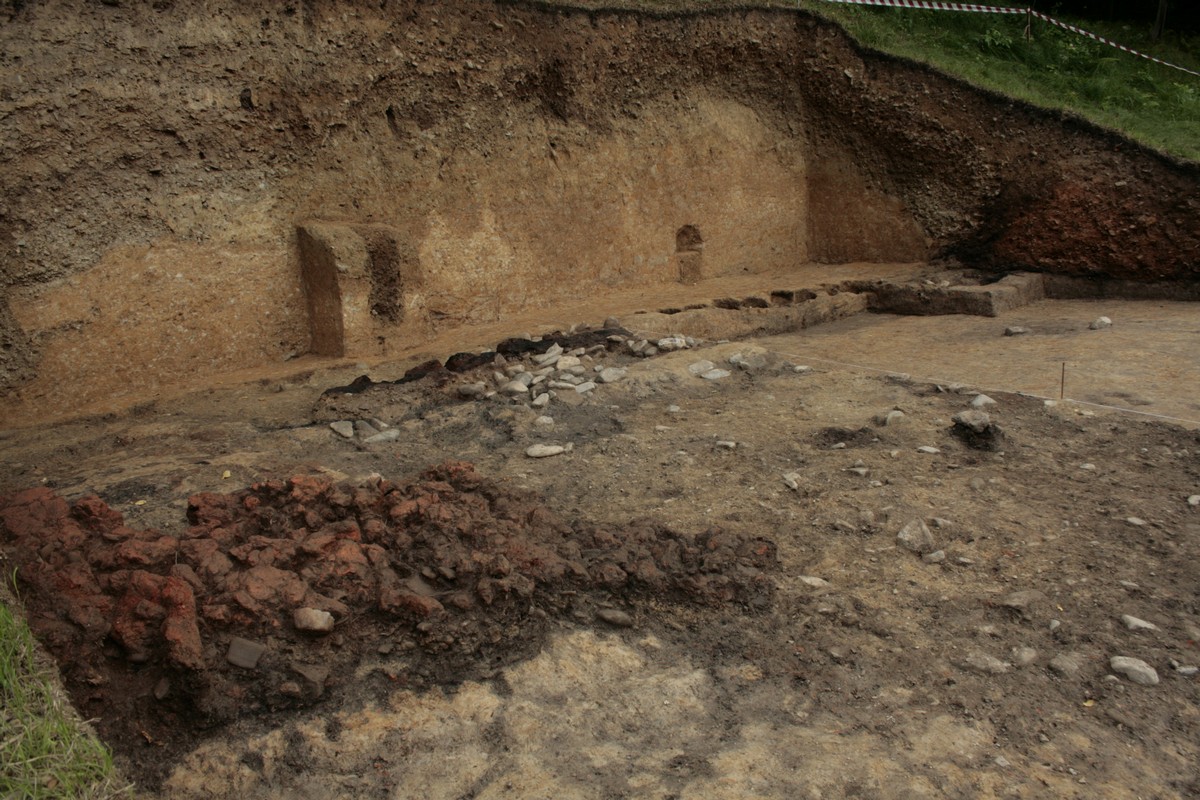
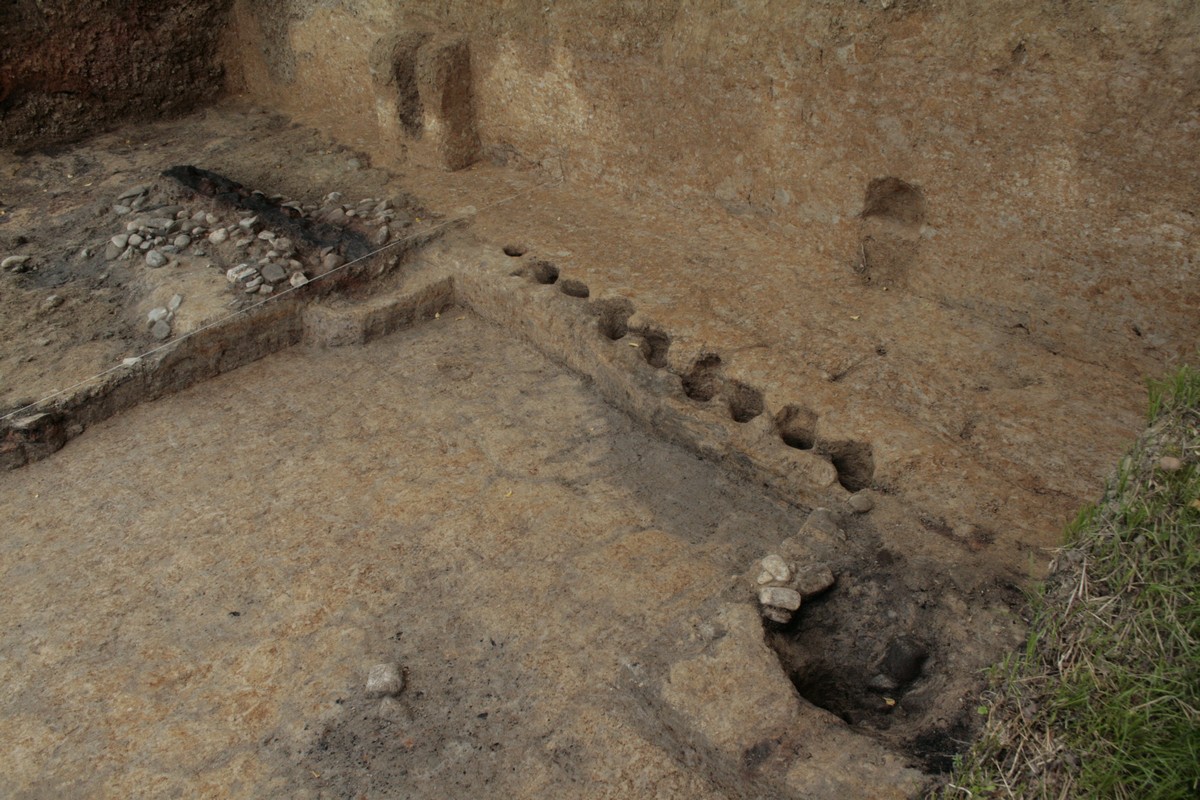 The largest part of the hillfort is represented by the first outer bailey with an area of 0.77 ha. Its fortification astonishes until today by its massiveness. The rampart extends in a wide arch from the northwest to the northeast, behind it follows a ditch 15-17 m wide, originally with a distinct V-shaped bottom. The elevation difference between the ditch and the crown of the rampart is today at some places 7–7.5 m. This rampart was probably equipped with a terrace walkway similar to that which is reconstructed in the Archaeopark. Production facilities and utilitarian features were found at the foot of the rampart: iron and textile production facilities, places for roasting and drying of grain as well as for stabling of cattle. In the bailey also occurred a feature, which has been interpreted as a cultic place and whose reconstruction is now situated at the acropolis. It seems that the main traffic and everyday life have taken place in this part of the hillfort.
The lowest-situated part of the settlement is the second outer bailey where the settlement has been least intensive. The rampart encloses this area at a length of 150 m on the western side, but does not continue towards the south and southeast and does not reach as far as the eastern steep slope. Taking into consideration that the ditch also is shallow and indistinct here, it has been supposed that this part of the fortification was not finished.