

Early middle ages
The earliest phase of Slavic history is called the Early Slavic Period and together with the subsequent centuries it corresponds to the Early Middle Ages.
The first Slavs appeared on our territory in about the second half of the 6th century AD. Around the mid-7th century the so-called Empire of Samo was established here – a free tribal union which arose on the basis of insurrection against the Avars, to whom the Slavs have been subordinate. This polity broke up after the death of Samo. The Avar Khaganate, the core of which was situated in Pannonia, represented the dominant power in the Middle Danube region until as late as the 9th century. The Frankish King Charlemagne organised a big military campaign against the Khaganate in 791. The Avar Empire has not recovered from this hard intervention and came to an end. In East-Central Europe thus emerged a power vacuum thanks to which a new Slavic state – Great Moravia – could be established. This polity has gradually expanded from the original South Moravian centres into the entire Morava River basin and subsequently conquered vast territories. In the last third of the 9th century, above all under Duke Svatopluk, the Great Moravian Empire attained a true political supremacy in East-Central Europe.
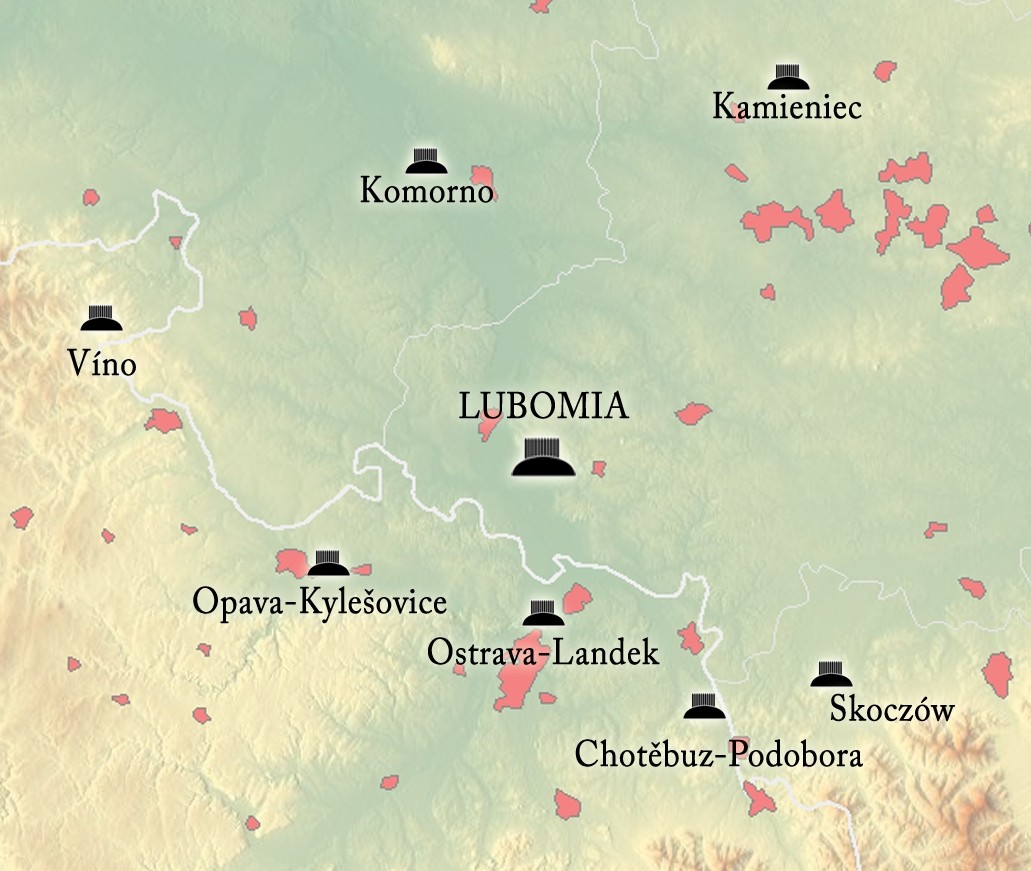
The map of Upper Silesian strongholds
The Slavs settled the locality of Chotěbuz-Podobora in about the mid-8th century, that is about 1,200 years after the decline of the Hallstatt Period hillfort. Chotěbuz counted among the local group of Upper Silesian strongholds. Besides Chotěbuz it also contained Kamieniec, Skočov, Landek, Kylešovice, Hradec, Mokre, Víno, Komorno and above all the large main centre at Lubom. As regards the tribal affiliation of these Slavs, they have mostly been identified as the Golensizi. In this context, Chotěbuz is rather situated at the edge of the territory outlined. The excavations also showed that the right bank of the river Olza was occupied much more densely than the left one. Chotěbuz, just as the other smaller strongholds, thus may have played the role of some advanced small fortress of the Lubom centre, which was enclosed by a defensive ring composed of the other settlements.
Did you know that:
This campaign is mentioned in the Legend on the Life of Saint Methodius. It informs us that the Duke of the Wislans refused baptism, which may have been a pretext by Svatopluk to organise a military action. The legend with its genre does not represent a historiographic work, but the descriptions of particular similar events are most probably based on truth.
The Slavs utilized the terrain relics of the Hallstatt Period fortification: they raised the ramparts, equipped them with a wooden defensive wall and partly extended them. In this initial phase of the early medieval settlement, the hillfort existed about hundred years until a violent intervention from outside. These events might be connected with the supposed attack of the Great Moravian army on tribal union of the Lesser Polish tribe of the Wislans in the 880s. Such a military campaign would have to pass through the territory under review. And indeed, the evidence of a violent downfall is also found in the other Upper Silesian strongholds inclusive of Lubom. The extent of destruction throughout the region indicates some larger military action, one of a sort which Great Moravia was able to organise.
Chotěbuz-Podobora is extraordinary in this regard, because it was not destroyed. The interpretation of find contexts concerning the fortification together with the objects of Great Moravian origin found indicate that the hillfort was spared from destruction. This is probably associated with power ambitions of the Great Moravian Empire – our site namely represents a good base enabling to control the local part of Silesia.
Did you know that:
Among exceptional objects found in the hillfort counts a perfectly preserved denarius of the Hungarian King Stephen (997-1038). The coin is interesting because it was discovered in the demise horizon of the hillfort – it means that it must have got there either after the decline of the hillfort or during the last years of its existence. This way it helps to identify the approximate time of decline and shows at the same time that the trade routes following the river Olza still passed through the region.
The mighty demise layers which have been unearthed during archaeological excavations would then be connected with a collapse of the power system of Great Moravia, which set in after the sudden break-up of the Empire in the first decades of the 10th century as a result of internal problems and the Magyar incursions into South Moravia. Anyway, the local settlement did not decline after the fall of the Empire, either – the evidence of life in the stronghold appeared among archaeological material after the mid-10th century as well. The site, however, has never achieved its previous significance again. More viable proved to be the nearby settlement on Castle Hill on the opposite bank of the river. Here gradually arose a hillfort which became the base of later castle and town of Ciezsyn. The settlement at Chotěbuz thus definitely declined in about the mid-11th century by a gradual abandonment of the place.